Elevate the power of your work
Get a FREE consultation today!
The industry is in overdrive to reconfigure its power and cooling to meet the soaring demands of AI. Power grids are struggling to meet this demand in many places, and many people who had no clear idea of what a data center was a year ago now have strong opinions on this. Grid support is an opportunity, let´s not blow it.

Director of Energy & Sustainability Strategy, Iron Mountain Data Centers
The industry is in overdrive to reconfigure its power and cooling to meet the soaring demands of AI. Power grids are struggling to meet this demand in many places, and many people who had no clear idea of what a data center was a year ago now have strong opinions on this, including politicians. But we hold the answer: helping grids to shave peaks by designing in flexible dispatchable power. It´s not too complicated, and it puts us firmly on the right side of progress during the energy transition. Grid support is an opportunity, let´s not blow it.
It is dawning on operators everywhere that self-generated energy will be the key to meeting growing demand, whether it is an islanded microgrid or a hybrid power solution. A recent survey by Bloom Energy highlights how quickly things have changed. It found that, faced with lengthening interconnection queues for grid connections, data center decision makers expect that by 2030, 38% of facilities will have at least some onsite power generation, and 27% of facilities will be 100% independently powered. This contrasts with last year’s survey, which showed 13% partially self-powered and 1% fully self-powered by 2030. What a difference year makes!
There are a multitude of options for designing and building this power generation, but not all are in reach of the average colocation operator. They can be put under three headings: Generate your own power, vary the level of your load, or shift your load within the campus.
For most operators, buying or building a nuclear reactor would blow the budget, plus they take a long time to come online. Co-developing, or acquiring a massive piece of hydro, solar or wind capacity is also more appropriate for out-of-town hyperscale or neocloud campuses. Then there is colocating with turbines and a natural gas pipeline, which works in some regions, but is of course costly and carbon-intensive. There is also a huge amount of stranded backup generation capacity in data centers. Unfortunately nearly all of it is currently noisy and diesel-powered. Clearly we need to work on this, and new fuels like HVO and more effective after treatment and carbon capture will be key.
Varying the load - ramping workloads up and down to take advantage of troughs in demand and stabilise the broader grid load - is a good solution, as practised by heavy industry for many years. This has great potential to free up large amounts of stranded grid capacity. It works for training factories with uniform loads, like the Nvidia´s Omniverse DSX, but unfortunately it is not something that colocation operators with multiple customers can do.
This leaves shifting the load, and right now there is a cleaner, faster and more affordable solution: Battery Energy Storage Systems (BESS). Adding energy storage at the data center, in the form of grid-sized batteries, enables the data center to reduce its load on the grid when necessary, then increase its load later to recharge when capacity on the grid allows. This does not have to be a huge amount of power over a long period of time; in fact it may only require a few hours across the year.
BESS can bring a lot of benefits and it is practical to install on existing sites. We know because we are building a BESS at our NJE-1 data center in Edison, New Jersey.
The new 12 MW/23 MWh BESS has received utility and township approvals and will be ready for service, and supporting the local grid, by the end of the year. It is both behind the meter and in front of the data center, so that it can be dispatched as needed without any impact to our critical power systems, and it can support the entire IT load for hours if needed, reducing load on the grid.
The fact that our New Jersey data center also has an 18,000 panel rooftop solar array makes the solution design even more efficient and sustainable. Combining on-site solar with storage amplifies the benefits of each.
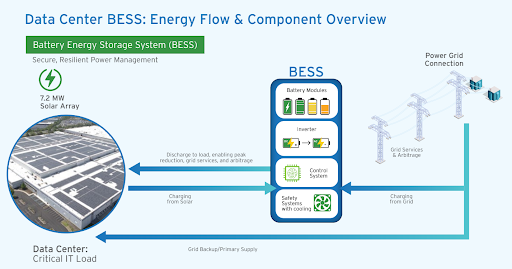
The system is quite simple. When the grid is under stress, it can discharge its capacity to reduce the power demands from the data center, keeping peak power usage down and stabilizing the grid. When demand has reduced, the BESS is recharged either from off-peak grid power or from on-site solar. In the summer, peak grid demand may occur as solar power subsides in the evening. Energy storage can ease this daily transition period, effectively prolonging the positive impact of solar. Savings are at their greatest when storage and solar reduce facility demand when the grid is experiencing peak usage.
This is a practical solution to a growing problem. The BESS approach for flexible power brings benefits to data center operators, their customers, utility operators, and communities. For utilities, a BESS can be counted on to perform when needed most, and it can enable more load to be interconnected to the existing grid. This allows the grid’s fixed costs to be shared across a larger base of delivered energy, putting downward pressure on electricity rates. Local communities also benefit from an optimized grid infrastructure with increased reliability.
This is a significant opportunity for the industry. As data centers consume more power in a power-constrained period of energy transition, deploying more battery systems can provide an important solution to grid congestion. It serves as a real-world template of how data centers can operate as dynamic grid partners, and an example of how the data center industry can bring grid solutions, not just challenges. There has never been a better time to build a BESS.
You can find out more about this and other flexible power solutions in the new IMDC paper, “Flexible Data Center Power: how we can help the grid”
Get a FREE consultation today!


